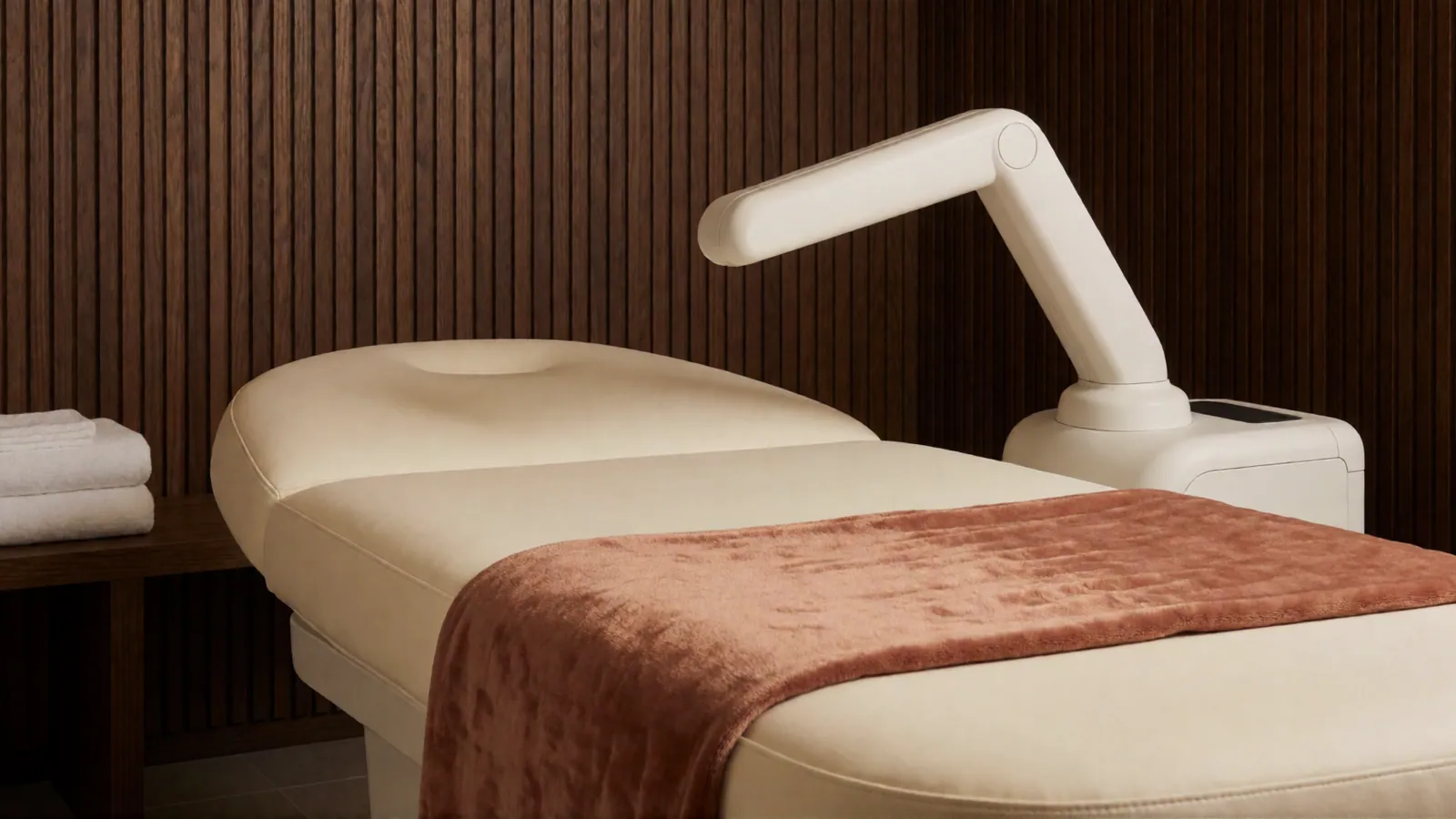
Some things people bring to a med spa need a doctor rather than a treatment room. Some things people bring to a med spa are not aesthetic problems and need a doctor rather than a treatment room. See a physician or a dermatologist, not us, if you have a mole or a mark that has changed shape, colour or size, or that bleeds, itches or will not heal; a sore anywhere that has been there more than three weeks; a rash you cannot explain; a patch of skin that is newly numb, hard or ulcerated; sudden hair loss in patches, or hair loss alongside fatigue or weight change; or swelling, heat and spreading redness that could be an infection. And if you have had filler treatment anywhere and the area becomes white or mottled, severely painful, or your vision changes, that is an emergency — telephone us immediately if we treated you, and go to an emergency room if you cannot reach somebody within minutes. We would far rather you rang a doctor and never rang us at all.
An applicator draws a pocket of fat between two cooling plates and holds it at a controlled low temperature for thirty-five to seventy-five minutes. Fat cells crystallise at a temperature that leaves skin, nerves and muscle unharmed, and the damaged cells are then broken down and cleared by the body over eight to twelve weeks. Published figures put the reduction at roughly twenty to twenty-five per cent of the fat in the treated pocket per session, which is a real and measurable change and a smaller one than most advertising implies.
The correct way to think about it is as sculpting rather than as slimming. It works on a discrete bulge that sits there regardless of diet and exercise — the pocket below the navel, the flanks, the inner thigh, the area under the bra strap, beneath the chin. It does not reduce your weight measurably, it does not treat general body fat, and it will do nothing whatsoever for somebody whose complaint is that they weigh more than they want to.
The most common reason we decline is skin rather than fat. If the tissue you can pinch is largely loose skin — after significant weight loss, after pregnancy, or simply with age — removing the fat beneath it makes the looseness more obvious rather than less. That is a disappointing thing to be told and it is far less disappointing than finding it out three months after paying for four applicators.
Who it suits and who it does not
The assessment takes twenty minutes and it decides everything.
A pinchable pocket, firm skin, stable weight
The ideal candidate is close to their usual weight, has a defined bulge they can hold between their fingers, and has skin that springs back. One to three sessions on that area produce a change that is visible in clothes and in the mirror.
Loose skin rather than fat
The commonest reason we say no. Emptying a pocket that is mostly skin leaves more slack, not less. Radiofrequency tightening helps a little; a surgeon helps properly; we will tell you which conversation you are actually in.
Firm, deep abdominal fat
Some abdominal fullness is visceral — behind the muscle wall rather than under the skin — and no external device can reach it. It is recognisable on examination because you cannot pinch it. It also responds well to weight loss, which is a different page and an honest recommendation.
Anybody wanting weight loss
This is not that, and we will not sell it as that. It changes a shape by a modest amount in one place. If your goal is to weigh less, /medical-weight-management.html is the honest page, and if your weight is already healthy the honest answer may be that nothing here is what you need.
The session and the three months after
Slow, undramatic, and easy to lose faith in around week six.
The session
Thirty-five to seventy-five minutes per applicator. Intense cold and a strong pulling sensation for the first ten minutes, then numbness, then boredom — people read or work. Afterwards the treated area is a firm cold lump which is massaged for a couple of minutes, which is briefly unpleasant and improves the result.
The first fortnight
Redness, swelling, bruising, numbness and occasional tingling or itching in the area. Numbness can persist for several weeks and is normal. Some people get a deep ache for a few days, which ordinary painkillers manage.
Weeks four to twelve
Where the change actually happens, gradually enough that you will probably not notice it. The result of a session is assessed at twelve weeks, not before, and a second session on the same area is not booked until then.
One to three sessions per area
Each removing a proportion of what remains. Most people have two. You pay per applicator as you go, you are assessed at twelve weeks before deciding on another, and there is no package to complete.
Risks, including the rare one
Mostly predictable, with one uncommon complication that anybody considering this should know about.
Expected effects
Bruising, swelling, redness, numbness for weeks, and occasional aching or nerve-type pain for several days. Nearly everybody gets some of these and they resolve without treatment.
Paradoxical fat growth
The rare one, and the reason it is on this page rather than in a form. In a small number of people — figures vary, and it is uncommon — the treated area responds by enlarging rather than shrinking, some months later, forming a firm mass in the shape of the applicator. It does not resolve by itself and correcting it requires surgery. You should know this before you agree to treatment, not afterwards.
Skin injury from cooling
Uncommon with correct technique and adequate skin protection. Anybody with a condition where cold provokes a reaction is excluded, which is why we ask about it specifically.
We will not treat
Anybody with a cold-related condition such as cold urticaria or cryoglobulinaemia; anybody pregnant; over a hernia or an untreated abdominal wall defect; over an area of altered sensation; anybody whose complaint is loose skin; and anybody hoping for weight loss.
Body Contouring in western Queens
Controlled cooling destroys fat cells in a defined pocket and the body clears them across three months. It treats a shape, not a weight, and it is the most oversold category in aesthetics.
Every treatment here starts the same way: a full hour at a table in a room with no treatment couch in it, a proper medical history, your skin looked at in daylight, and then a plain statement of what we think would achieve what you described. You are told what it costs, how many sessions it usually takes, how long it lasts, what the recovery looks like and what can go wrong — on paper, to take home and read somewhere other than a treatment room. If the honest answer is a different treatment, or nothing, or a dermatologist, that is what you get instead, and it costs exactly the same.
Aesthetic treatment is elective medicine, and this page is not medical advice for you. Aesthetic treatment is elective, it is medicine wherever it breaks the skin, and nothing on this website is medical advice for you in particular. We do not diagnose disease. Every treatment here begins with a consultation and a medical history, because your health, your medication, your skin type and what you have had done before all change what is safe and what is sensible. Some people are told no. Being told no is a normal outcome of a consultation here rather than a failure of one, and it costs exactly the same as being told yes.
No before-and-after photographs, and no promised outcome. There are no before-and-after photographs on this website and there never will be. Every set you have seen somewhere else was chosen from a much larger pile, and the second picture is usually taken in different light, at a different angle, at a different time of day, often with makeup and frequently after retouching. Even an entirely honest pair shows you what happened to somebody else's face. What we publish instead is what a treatment typically changes, by roughly how much, how long it lasts, how many sessions it usually takes and how often people are disappointed. We do not guarantee an outcome, we cannot, and anybody who does is either guessing or selling.
The risks, plainly. Every treatment on this site has side effects and some carry real risks. The common ones are minor and short-lived — redness, swelling, tenderness, bruising, a day or two of looking like you have had something done. The uncommon ones matter more: burns, blistering and long-lasting pigment change from light-based treatment, which is a greater risk on deeper skin tones and on recently tanned skin; infection anywhere the skin is broken; and lumps, asymmetry and, very rarely, a blocked blood vessel from injectable filler, which is the one true emergency in this field. We screen for what makes each of these more likely, we tell you your own risk rather than the average one, and we decline to treat when the answer should be no.
What a med spa does not treat. We treat the appearance of healthy skin, hair and body. We do not diagnose or treat disease. If you bring us a mole, a changing mark, an unexplained rash, a sore that will not heal, skin that has become hard or numb, psoriasis, eczema, an autoimmune skin condition, or hair loss that came on suddenly or in patches, what you will get is the name of a doctor rather than a treatment plan. Aesthetic treatment applied on top of an undiagnosed skin problem can mask it, delay the diagnosis and occasionally make it worse. We would rather lose the booking.
Questions
Body Contouring — the questions we are asked most
How much fat will it actually remove?
Published figures are around twenty to twenty-five per cent of the fat in the treated pocket per session, which is real and is smaller than the advertising suggests. In practice that means a visible change in the shape of a specific bulge, not a change in your weight or your clothes size. Most people have two sessions on an area.
Will I lose weight?
No, and anybody who tells you otherwise is mis-selling it. The amount of tissue removed is too small to register on a scale. This treatment changes the shape of one area. If weight is the goal, this is the wrong treatment and we will say so at the consultation rather than take the booking.
Does the fat come back?
The fat cells destroyed do not return. The fat cells you still have — everywhere, including in the treated area — can enlarge if you gain weight, so the result depends on your weight staying broadly stable. It is best understood as permanently reducing the number of cells in one pocket rather than as a guarantee about your future shape.
What is paradoxical fat growth?
An uncommon complication in which the treated area enlarges rather than shrinks, several months later, forming a firm mass roughly the shape of the applicator. It does not resolve on its own and correcting it needs surgery. It is uncommon, it is real, and you should hear about it before agreeing to treatment rather than reading it in a consent form in the room.
Does it hurt?
The first ten minutes are intensely cold with a strong pulling sensation, then the area goes numb and the rest is uneventful. The two-minute massage immediately afterwards is the most uncomfortable part. Some people have a deep ache for a few days afterwards that ordinary painkillers handle.
Can it help my loose skin after weight loss?
No — it makes it worse. Removing fat from beneath skin that is already slack leaves more slack. This is the commonest reason we decline to treat somebody, and the honest answer for significant loose skin is a surgeon rather than any device in this building.
Related
Often seen alongside this
Body, Hair & Wellness
Cellulite Treatment
Cellulite is a structural feature of normal skin, not a disease and not a sign of anything. It can be improved somewhat. It cannot be cured, and this page is more sceptical than most about what is on offer.
Read more
Body, Hair & Wellness
Hair Restoration
Your own blood is spun to concentrate the platelets, and the concentrate is injected into the scalp to stimulate thinning follicles. It works on hair that is thinning, not on scalp where hair has gone.
Read more
Body, Hair & Wellness
IV Hydration Therapy
Fluid and, where appropriate, vitamins delivered into a vein across forty minutes. Genuinely useful when somebody is dehydrated. Not a detox, not an immune treatment, and not better than drinking water.
Read moreA written plan and a written price before anything is booked
Book a consultation
Pick a clinician and an hour from the calendar — it shows only the times each of them genuinely has free. A consultation is a full hour at a table with no treatment couch in the room, and it costs $85, or $120 with the medical director. If you go ahead, that comes off your first treatment. If we tell you the answer is nothing, or a dermatologist, it costs exactly the same.