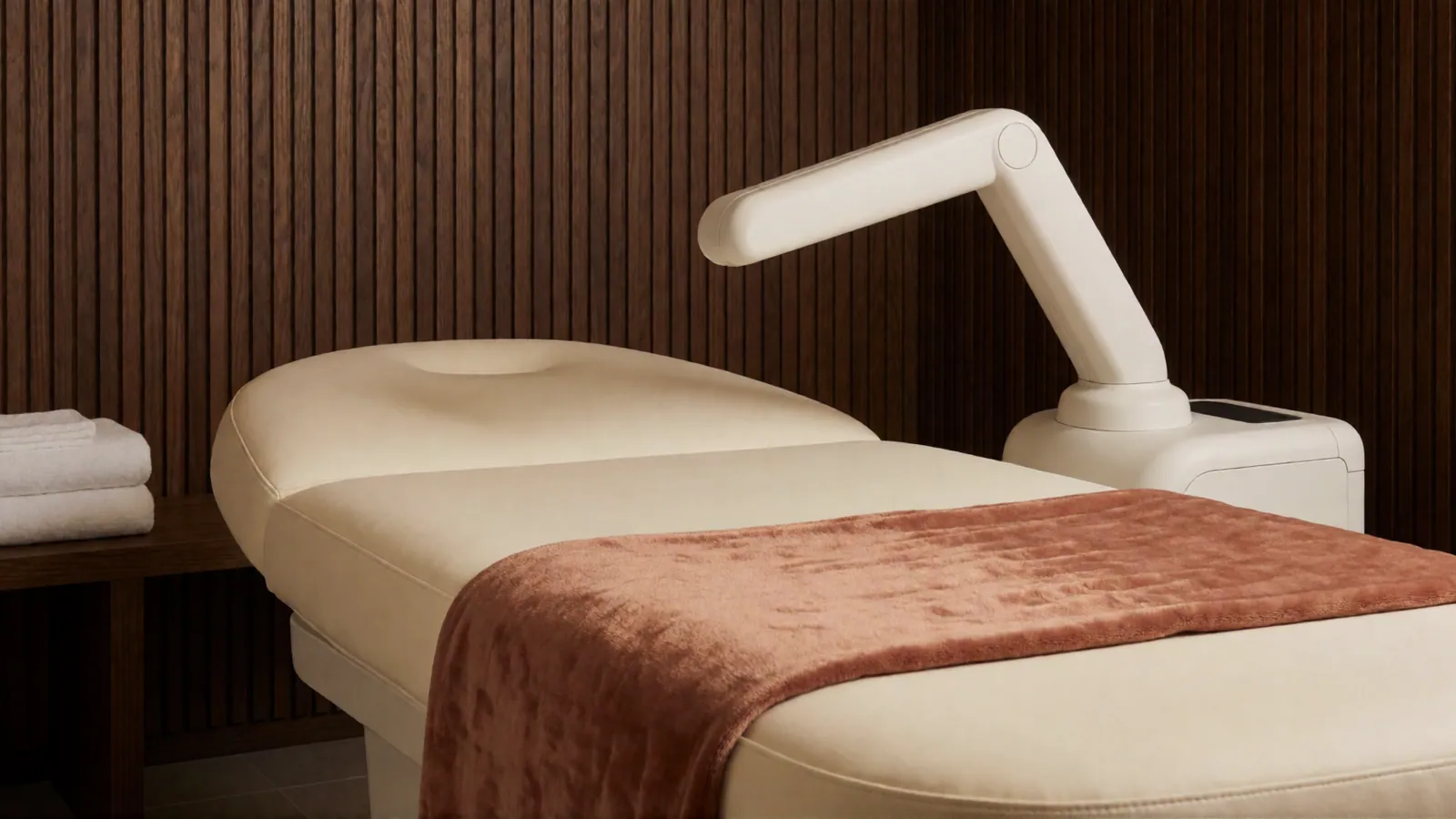
Some things people bring to a med spa need a doctor rather than a treatment room. Some things people bring to a med spa are not aesthetic problems and need a doctor rather than a treatment room. See a physician or a dermatologist, not us, if you have a mole or a mark that has changed shape, colour or size, or that bleeds, itches or will not heal; a sore anywhere that has been there more than three weeks; a rash you cannot explain; a patch of skin that is newly numb, hard or ulcerated; sudden hair loss in patches, or hair loss alongside fatigue or weight change; or swelling, heat and spreading redness that could be an infection. And if you have had filler treatment anywhere and the area becomes white or mottled, severely painful, or your vision changes, that is an emergency — telephone us immediately if we treated you, and go to an emergency room if you cannot reach somebody within minutes. We would far rather you rang a doctor and never rang us at all.
Radiofrequency energy passes through the surface of the skin and generates heat in the layer beneath, typically bringing it to somewhere between 40 and 45 degrees. At those temperatures existing collagen fibres contract slightly, and the tissue responds to the heat by producing new collagen over the following three to six months. The surface is cooled throughout, which is why there is no downtime.
Its great advantage over light-based treatment is that radiofrequency does not care about pigment. It is not absorbed by melanin, so it is equally safe on every skin tone, and it can be used in summer and on tanned skin. For clients with richer skin who have been told they are not a candidate for various laser treatments, this is frequently the answer, and it is one of the reasons we offer it.
Its disadvantage is the honest one: the effect is modest. A realistic description is a mild tightening and a slight improvement in the definition of a jawline or the texture of an upper arm, arriving gradually, requiring a course of four to six and maintenance thereafter. Anybody selling this as an alternative to surgery is selling you something it is not. Where somebody genuinely has loose skin that bothers them, the honest answer is often a surgeon, and we will say so.

What a realistic result looks like
Four honest statements, in place of the language usually used to sell this.
A modest tightening, not a lift
Skin that is slightly firmer and slightly better defined along the jaw, under the chin or on the abdomen. Visible to you and to somebody who knows your face well; frequently not visible to a stranger. That is what the treatment does, and pretending otherwise is how people end a course feeling cheated.
Gradual, across three to six months
There is a small immediate effect from collagen contracting on the day, which fades within a week and is not the result. The actual change accumulates across the course and for months after the last session, in exactly the way people find hardest to trust.
Best on mild laxity
It suits early skin looseness — the jawline that has just started to soften, the neck that has just started to crêpe. It does very little for advanced laxity, and applying it to skin that genuinely hangs is a waste of a course.
Safe on every skin tone
Because the energy is not absorbed by pigment. This is a genuine advantage of this treatment over every light-based option, and it is why a good share of our clients with richer skin end up here.
The course
Comfortable, unglamorous and undemanding of your calendar — which is most of its appeal.
The session
Thirty to sixty minutes. A gel is applied and a handpiece is moved continuously over the area while it warms. Most people describe it as a hot stone massage that occasionally gets a little too hot, at which point you say so and the operator adjusts. There is no numbing and no discomfort worth mentioning.
Immediately afterwards
Pink for an hour or two, and that is the entire downtime. Makeup, gym, sun — all fine the same day. This is the treatment we suggest to people who cannot afford any recovery at all.
Four to six sessions
Spaced one to two weeks apart for the face, two to three weeks for the body. Assessed as you go, paid per session, stop whenever you want to.
Maintenance
One session every three to six months maintains the result. Stop entirely and the effect fades across a year or two, because you are still ageing at your usual rate underneath it.
Risks and reasons we decline
One of the safest treatments here, which is not the same as risk-free.
Burns
The main risk, and uncommon when the handpiece is kept moving and the temperature is monitored. It is more likely over bony areas, over metal, and on skin that has lost sensation and therefore cannot tell the operator it is too hot.
Fat loss
Reported occasionally with aggressive treatment of the face: heat can affect the fat pads beneath skin and leave an area looking hollower rather than tighter. Conservative settings and avoiding thin faces is how this is avoided, and it is a reason we do not treat some people who ask.
Disappointment
Worth listing as a risk because it is the commonest bad outcome. Somebody expecting a surgical result from a non-surgical treatment will be unhappy however well the treatment is delivered, which is why the consultation spends most of its time on expectation rather than on settings.
We will not treat
Over an implanted electrical device such as a pacemaker; over metal implants in the treatment area; anybody pregnant; over an active skin infection; over an area with reduced sensation; and anybody whose laxity is advanced enough that we would be taking money for very little.
Radiofrequency Skin Tightening in western Queens
Controlled heat delivered into the deeper layers of skin, which contracts existing collagen a little and provokes new collagen over months. A modest, gradual treatment that is routinely over-sold as a face lift.
Every treatment here starts the same way: a full hour at a table in a room with no treatment couch in it, a proper medical history, your skin looked at in daylight, and then a plain statement of what we think would achieve what you described. You are told what it costs, how many sessions it usually takes, how long it lasts, what the recovery looks like and what can go wrong — on paper, to take home and read somewhere other than a treatment room. If the honest answer is a different treatment, or nothing, or a dermatologist, that is what you get instead, and it costs exactly the same.
Aesthetic treatment is elective medicine, and this page is not medical advice for you. Aesthetic treatment is elective, it is medicine wherever it breaks the skin, and nothing on this website is medical advice for you in particular. We do not diagnose disease. Every treatment here begins with a consultation and a medical history, because your health, your medication, your skin type and what you have had done before all change what is safe and what is sensible. Some people are told no. Being told no is a normal outcome of a consultation here rather than a failure of one, and it costs exactly the same as being told yes.
No before-and-after photographs, and no promised outcome. There are no before-and-after photographs on this website and there never will be. Every set you have seen somewhere else was chosen from a much larger pile, and the second picture is usually taken in different light, at a different angle, at a different time of day, often with makeup and frequently after retouching. Even an entirely honest pair shows you what happened to somebody else's face. What we publish instead is what a treatment typically changes, by roughly how much, how long it lasts, how many sessions it usually takes and how often people are disappointed. We do not guarantee an outcome, we cannot, and anybody who does is either guessing or selling.
The risks, plainly. Every treatment on this site has side effects and some carry real risks. The common ones are minor and short-lived — redness, swelling, tenderness, bruising, a day or two of looking like you have had something done. The uncommon ones matter more: burns, blistering and long-lasting pigment change from light-based treatment, which is a greater risk on deeper skin tones and on recently tanned skin; infection anywhere the skin is broken; and lumps, asymmetry and, very rarely, a blocked blood vessel from injectable filler, which is the one true emergency in this field. We screen for what makes each of these more likely, we tell you your own risk rather than the average one, and we decline to treat when the answer should be no.
What a med spa does not treat. We treat the appearance of healthy skin, hair and body. We do not diagnose or treat disease. If you bring us a mole, a changing mark, an unexplained rash, a sore that will not heal, skin that has become hard or numb, psoriasis, eczema, an autoimmune skin condition, or hair loss that came on suddenly or in patches, what you will get is the name of a doctor rather than a treatment plan. Aesthetic treatment applied on top of an undiagnosed skin problem can mask it, delay the diagnosis and occasionally make it worse. We would rather lose the booking.
Questions
Radiofrequency Skin Tightening — the questions we are asked most
Is this a non-surgical face lift?
No, and we will not describe it as one. It produces a modest tightening and a gradual improvement in skin quality across months. A face lift repositions tissue surgically and produces a change of an entirely different order. Clinics that use the phrase are borrowing the credibility of an operation for a treatment that does something much smaller.
Is it safe on darker skin?
Yes — this is one of its real advantages. Radiofrequency energy is not absorbed by melanin, so unlike light-based treatment it carries no additional pigment risk on richer skin tones, and it can be performed in summer and on tanned skin. It is frequently the right answer for people who have been turned away from laser treatments.
How soon will I see something?
There is a small immediate tightening on the day that fades within a week and is not the result. The real change accumulates across the course and for three to six months after the final session. Judging this treatment at session two is judging it far too early.
How many sessions?
Four to six for most areas, one to three weeks apart, then a maintenance session every three to six months if you want to keep it. Paid per session as you have them.
Does it hurt?
No. It feels like a warm stone massage that occasionally gets a little too hot, at which point you say so and the operator adjusts. That feedback is part of how the treatment is kept safe, so being told it is getting hot is useful rather than a complaint.
Will it help my loose skin after weight loss?
A little, and probably not enough. Skin that has been substantially stretched and then emptied has lost structure that heat cannot rebuild, and the honest answer for significant loose skin is a surgeon. We will tell you that at the consultation rather than sell you six sessions that will disappoint you.
Related
Often seen alongside this
Laser & Light
Laser Hair Reduction
The most reliably satisfying treatment in this building, provided the expectation is right: it is a permanent reduction rather than a permanent removal, and it takes a course spread across months.
Read more
Laser & Light
Laser Skin Resurfacing
Controlled removal of the surface of the skin so that it heals back smoother, or controlled heating beneath it without breaking the surface. The first works better; the second costs you nothing in downtime.
Read more
Laser & Light
IPL Photofacial
A broad flash of filtered light absorbed by brown patches and red vessels, which breaks them up so the body can clear them. Excellent for sun damage on lighter skin — and genuinely risky on richer skin.
Read moreA written plan and a written price before anything is booked
Book a consultation
Pick a clinician and an hour from the calendar — it shows only the times each of them genuinely has free. A consultation is a full hour at a table with no treatment couch in the room, and it costs $85, or $120 with the medical director. If you go ahead, that comes off your first treatment. If we tell you the answer is nothing, or a dermatologist, it costs exactly the same.