Some things people bring to a med spa need a doctor rather than a treatment room. Some things people bring to a med spa are not aesthetic problems and need a doctor rather than a treatment room. See a physician or a dermatologist, not us, if you have a mole or a mark that has changed shape, colour or size, or that bleeds, itches or will not heal; a sore anywhere that has been there more than three weeks; a rash you cannot explain; a patch of skin that is newly numb, hard or ulcerated; sudden hair loss in patches, or hair loss alongside fatigue or weight change; or swelling, heat and spreading redness that could be an infection. And if you have had filler treatment anywhere and the area becomes white or mottled, severely painful, or your vision changes, that is an emergency — telephone us immediately if we treated you, and go to an emergency room if you cannot reach somebody within minutes. We would far rather you rang a doctor and never rang us at all.
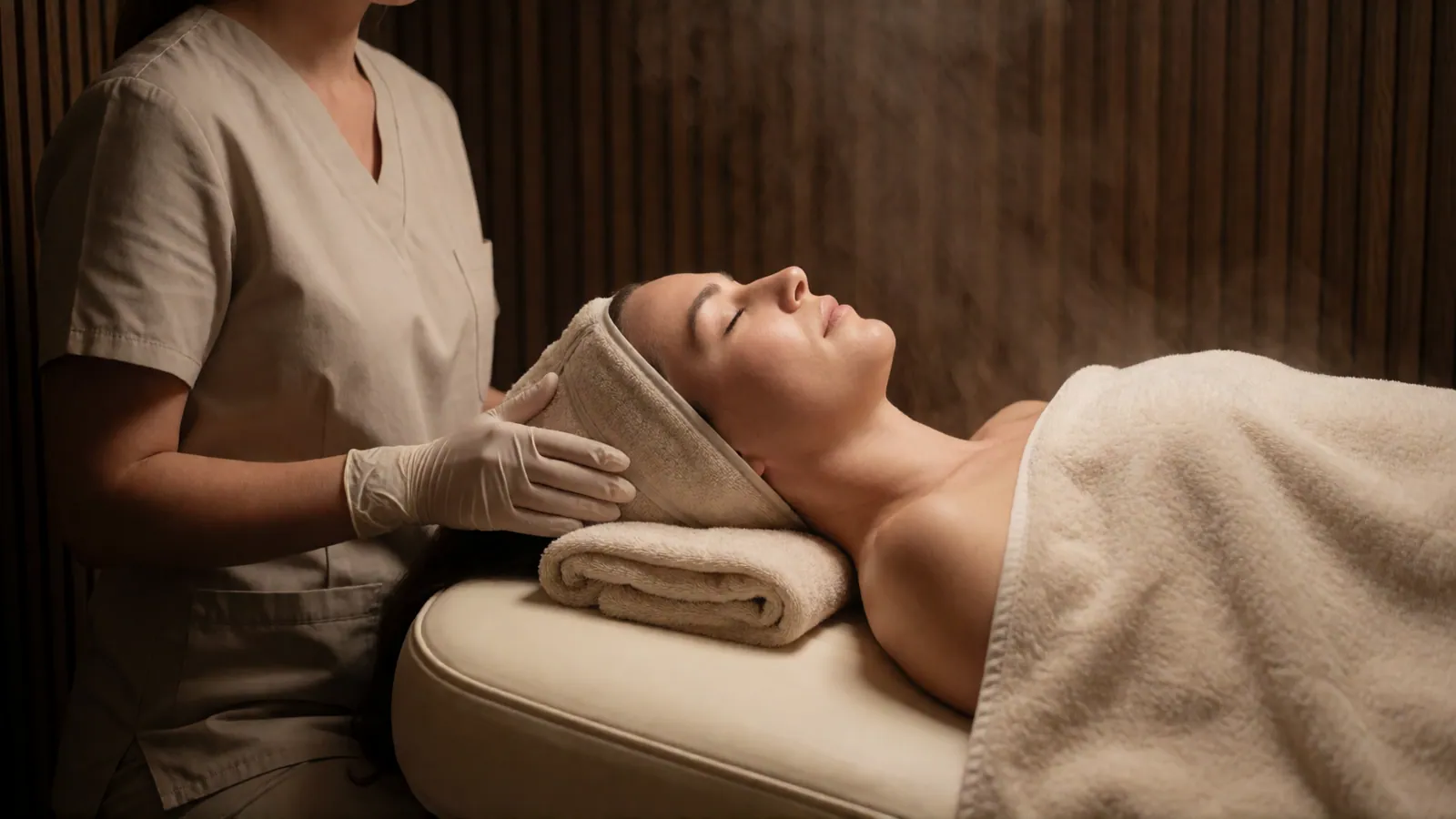
The difference between this and a spa facial is what is in the bottles and who chose them. A cleanse, a professional-strength exfoliation appropriate to your skin that week, extractions where they are needed and will not cause damage, an active treatment aimed at whatever the actual problem is, and a barrier-repairing finish. There is often a massage, because it is pleasant and improves lymphatic drainage, but the massage is not the treatment.
What it achieves, honestly, is a gradual improvement in the surface of skin: clearer pores, more even tone, better texture and fewer breakouts, arriving over three or four appointments rather than in one. The single session before an event is a real thing and it works — skin does look better for a few days afterwards — but the change people actually want comes from a course spaced every four to six weeks, which is how often skin turns over.
It is also the treatment we most often recommend to somebody who came in asking for an injectable. A great deal of what people read as ageing in a mirror is surface quality — dullness, uneven tone, rough texture, congestion — and none of that is improved by relaxing a muscle or adding volume. Six months of consistent skin treatment and a sensible home routine changes how a face looks in a way that costs less and lasts longer than most people expect.
What actually happens in the hour
Four stages, adjusted every visit to the skin that arrives rather than to a fixed protocol.
Assessment, every time
Under a magnifying light, and it takes four minutes. Skin changes with the season, with stress, with medication and with whatever you have been putting on it, so the treatment is decided on the day. A facial that is identical every visit is a menu item rather than a treatment.
Cleansing and exfoliation
Two cleanses, then an exfoliation appropriate to the week: an enzyme if your barrier is fragile, an acid if it is not, at a strength that would not be sold to you to take home. This is the part that does most of the work.
Extractions, where they are appropriate
Congestion is removed with steam and correct technique, and only where it will come away without damage. Forcing a lesion that is not ready is how people end up with a mark that lasts three months. Thandiwe will leave things alone and tell you why, which some clients find frustrating and all of them are better off for.
Active treatment and barrier repair
Something aimed at the actual problem — pigment, oil, inflammation, dehydration — followed by something that puts the barrier back and a sunscreen. You leave slightly pink at most, and you can go straight back to work.
What it will and will not do
The honest boundaries, so nobody buys six of these expecting the wrong thing.
Texture, tone and congestion
Genuinely improved across a course. Skin that is smoother to the touch, more even in colour, with smaller-looking pores and fewer blocked ones. This is what the treatment is for and it delivers it reliably.
Mild acne and post-acne marks
Helped considerably, particularly alongside the right home routine. Moderate to severe acne needs a dermatologist and often a prescription first — we will say so, and we are happy to work alongside that treatment rather than instead of it.
Lines and volume
Barely, and we will not claim otherwise. Better hydrated, better-quality skin makes fine lines less obvious. It does not fill them and it does not lift anything. If lines are your main concern, resurfacing, microneedling or an injectable is the honest conversation.
A permanent fix
There is not one. Skin is maintained rather than repaired once. Stop coming and stop the home routine and it drifts back across six to twelve months. That is the nature of the organ rather than a commercial arrangement, and it is why we would rather you spent your money on a sensible routine than on a monthly appointment you cannot sustain.
How often, and what it costs to keep it up
This is where we would rather talk you out of spending money than into it.
Every four to six weeks, for a course
Four sessions is a reasonable trial. If your skin is not measurably better by the fourth, the plan is wrong and we will change it or tell you to stop rather than book a fifth.
Then as often as you like
Some people continue every six weeks; plenty come quarterly; some stop entirely and maintain it at home. All of those are legitimate. Nobody here will telephone you to ask why you have not rebooked.
The home routine matters more than we do
An honest ranking: daily sunscreen first, a sensible routine second, professional treatment third. A client with an excellent home routine and two facials a year will have better skin than one with monthly facials and no sunscreen. We would rather say that than pretend the appointment is the important part.
No packages, as everywhere here
Each session paid as you have it. Buying six in advance means paying us before anybody knows whether the treatment suits you, and it is a commitment device rather than a discount.
Medical-Grade Facials in western Queens
A facial performed by a licensed aesthetician using professional-strength actives, chosen for your skin rather than from a menu. It is treatment rather than pampering, and it is where most people should begin.
Every treatment here starts the same way: a full hour at a table in a room with no treatment couch in it, a proper medical history, your skin looked at in daylight, and then a plain statement of what we think would achieve what you described. You are told what it costs, how many sessions it usually takes, how long it lasts, what the recovery looks like and what can go wrong — on paper, to take home and read somewhere other than a treatment room. If the honest answer is a different treatment, or nothing, or a dermatologist, that is what you get instead, and it costs exactly the same.

Aesthetic treatment is elective medicine, and this page is not medical advice for you. Aesthetic treatment is elective, it is medicine wherever it breaks the skin, and nothing on this website is medical advice for you in particular. We do not diagnose disease. Every treatment here begins with a consultation and a medical history, because your health, your medication, your skin type and what you have had done before all change what is safe and what is sensible. Some people are told no. Being told no is a normal outcome of a consultation here rather than a failure of one, and it costs exactly the same as being told yes.
No before-and-after photographs, and no promised outcome. There are no before-and-after photographs on this website and there never will be. Every set you have seen somewhere else was chosen from a much larger pile, and the second picture is usually taken in different light, at a different angle, at a different time of day, often with makeup and frequently after retouching. Even an entirely honest pair shows you what happened to somebody else's face. What we publish instead is what a treatment typically changes, by roughly how much, how long it lasts, how many sessions it usually takes and how often people are disappointed. We do not guarantee an outcome, we cannot, and anybody who does is either guessing or selling.
The risks, plainly. Every treatment on this site has side effects and some carry real risks. The common ones are minor and short-lived — redness, swelling, tenderness, bruising, a day or two of looking like you have had something done. The uncommon ones matter more: burns, blistering and long-lasting pigment change from light-based treatment, which is a greater risk on deeper skin tones and on recently tanned skin; infection anywhere the skin is broken; and lumps, asymmetry and, very rarely, a blocked blood vessel from injectable filler, which is the one true emergency in this field. We screen for what makes each of these more likely, we tell you your own risk rather than the average one, and we decline to treat when the answer should be no.
What a med spa does not treat. We treat the appearance of healthy skin, hair and body. We do not diagnose or treat disease. If you bring us a mole, a changing mark, an unexplained rash, a sore that will not heal, skin that has become hard or numb, psoriasis, eczema, an autoimmune skin condition, or hair loss that came on suddenly or in patches, what you will get is the name of a doctor rather than a treatment plan. Aesthetic treatment applied on top of an undiagnosed skin problem can mask it, delay the diagnosis and occasionally make it worse. We would rather lose the booking.
Questions
Medical-Grade Facials — the questions we are asked most
How is this different from a facial at a day spa?
The strengths available and the person choosing them. A licensed aesthetician working in a medical setting can use actives at concentrations that are not sold over a counter and are not used in a general spa, and the treatment is chosen for the skin in front of her rather than picked from a menu. The massage and the pleasant hour are still there; they are simply not the point.
Will one facial make a difference before an event?
Yes, modestly, and it is a real thing rather than a myth — skin looks brighter and more even for several days. Book it a week beforehand rather than the day before, because extractions can leave small marks for a day or two, and never have your first-ever treatment in the same week as something important.
How often should I come?
Every four to six weeks for a course of four, which follows the rate skin actually turns over, and then as often as suits you. Quarterly is plenty for many people. We would rather you had four well-spaced sessions and a good home routine than twelve appointments and no sunscreen.
Is it safe for sensitive skin or rosacea?
For sensitive skin, yes — the treatment is adjusted, and enzymes replace acids. Rosacea is a medical diagnosis rather than a skin type, so if it has not been diagnosed we will send you to a dermatologist first. Once it has been, we are happy to treat gently alongside whatever your physician has prescribed.
Can I have extractions?
Where they are appropriate, yes, and not on demand. Congestion that is ready comes away cleanly; a lesion that is not ready leaves a mark that can last three months. Thandiwe will leave things alone and explain why, and that judgement is a large part of what you are paying for.
What should I not do beforehand?
No waxing or threading of the area for a week, no strong acids or retinoids for three days, and no fresh sunburn. Tell us about any acne medication you are taking, because several of them make skin considerably more fragile and change what is safe to do.
Related
Often seen alongside this

Skin & Facial Treatments
Hydradermabrasion Facial
A device that exfoliates, extracts and applies a serum in the same pass, using water and gentle suction. Reliably good at congestion and dullness, and reliably oversold as something transformative.
Read more
Skin & Facial Treatments
Chemical Peels
An acid applied for a controlled time to shed a controlled depth of skin. Depth is the whole game — a light peel is a lunchtime treatment you repeat, a medium peel is a genuinely peeling week and a real result.
Read more
Skin & Facial Treatments
Microneedling
Hundreds of tiny controlled punctures provoke a repair response, and the skin rebuilds slightly thicker and smoother. The workhorse of texture and scarring treatment, and safe on every skin tone.
Read moreA written plan and a written price before anything is booked
Book a consultation
Pick a clinician and an hour from the calendar — it shows only the times each of them genuinely has free. A consultation is a full hour at a table with no treatment couch in the room, and it costs $85, or $120 with the medical director. If you go ahead, that comes off your first treatment. If we tell you the answer is nothing, or a dermatologist, it costs exactly the same.