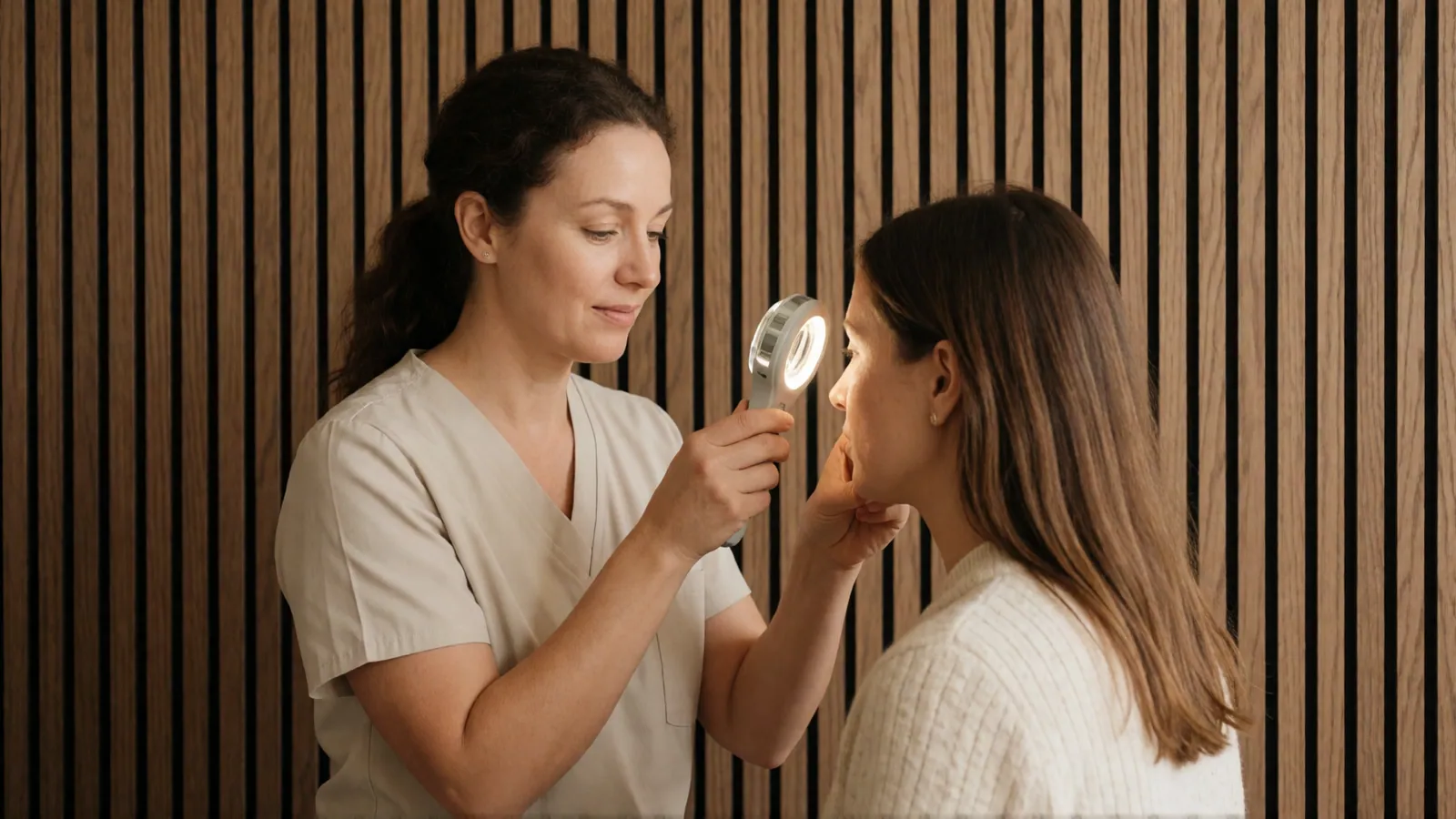
Some things people bring to a med spa need a doctor rather than a treatment room. Some things people bring to a med spa are not aesthetic problems and need a doctor rather than a treatment room. See a physician or a dermatologist, not us, if you have a mole or a mark that has changed shape, colour or size, or that bleeds, itches or will not heal; a sore anywhere that has been there more than three weeks; a rash you cannot explain; a patch of skin that is newly numb, hard or ulcerated; sudden hair loss in patches, or hair loss alongside fatigue or weight change; or swelling, heat and spreading redness that could be an infection. And if you have had filler treatment anywhere and the area becomes white or mottled, severely painful, or your vision changes, that is an emergency — telephone us immediately if we treated you, and go to an emergency room if you cannot reach somebody within minutes. We would far rather you rang a doctor and never rang us at all.
No before-and-after photographs, and no promised outcome. There are no before-and-after photographs on this website and there never will be. Every set you have seen somewhere else was chosen from a much larger pile, and the second picture is usually taken in different light, at a different angle, at a different time of day, often with makeup and frequently after retouching. Even an entirely honest pair shows you what happened to somebody else's face. What we publish instead is what a treatment typically changes, by roughly how much, how long it lasts, how many sessions it usually takes and how often people are disappointed. We do not guarantee an outcome, we cannot, and anybody who does is either guessing or selling.
In your words
Fourteen things people say, and what each one usually is
Each entry says what the cause normally turns out to be, what actually helps, and what does not — including the treatments people commonly ask for that would be the wrong tool.
Lines that appear when I move
Forehead lines, the two vertical lines between the brows, the fan at the outer corner of the eye. These are made by muscle, and relaxing that muscle is what softens them. Usually one treatment three or four times a year. What will not help: filling them, which is the wrong tool for a moving line. See Wrinkle-Relaxing Injections.
Lines that are there when my face is still
A different problem with a different answer, and the distinction matters more than almost anything else on this page. A crease visible in a completely relaxed face has become a fold in the skin itself, and relaxing the muscle beneath it helps very little. The treatments that reach it are resurfacing, microneedling and time. See Laser Skin Resurfacing and RF Microneedling.
I look flat, or tired, or hollow
Usually volume that has gone from under the cheek rather than anything wrong with the place you are pointing at. Supporting the structure lifts what is below it. Sometimes the honest answer is a collagen stimulator across several months instead. See Dermal Fillers and Collagen-Stimulating Injections.
Dark circles under my eyes
Four different causes needing four different answers, and filler is right for only one of them. If it is pigment, or a bulging fat pad, an injection makes things worse rather than better. Roughly half the people who ask for this here are advised against it. See Under-Eye Treatment.
Brown patches and sun damage
Years of ordinary daylight, showing on the face, chest and backs of the hands. Light-based treatment clears it well on lighter skin; on richer skin tones peels and topical treatment are safer and work. Nothing holds unless you wear sunscreen. See IPL Photofacial and Chemical Peels.
Pigment that is not sun damage
Melasma is hormonally driven, heat-sensitive as well as light-sensitive, and it behaves in the opposite way to sun damage under a bright light — several light-based treatments make it worse rather than better. Telling the two apart is the first thing the consultation does, and nothing available anywhere cures melasma. See Chemical Peels.
Redness and little visible vessels
Background flushing responds to broad-spectrum light; defined thread veins respond better to a vascular laser. If your redness has never been diagnosed, a dermatologist first is the right order. See Laser Vein Treatment and IPL Photofacial.
Acne, and the marks it leaves
Two problems, two treatments, and doing the second before the first is controlled wastes your money. Moderate or severe acne needs a dermatologist and often a prescription, and we will say so. The marks and the scarring afterwards are ours. See Microneedling and Chemical Peels.
Rough texture, big-looking pores, dull skin
The most improvable thing on this list and the least glamorous. It moves across months rather than weeks, with facials, peels and needling, and the home routine matters more than the appointments do. See Medical-Grade Facials and Microneedling.
Hair I am tired of removing
Laser reduction works reliably on pigmented hair and does nothing at all on blonde, red, grey or white hair — no laser anywhere does. It is a permanent reduction rather than a permanent removal, and it takes a course across months. See Laser Hair Reduction.
A pocket of fat that will not shift
If you can pinch it, if it is fat rather than loose skin, and if your weight is stable, it can be reduced. If it is loose skin, removing the fat beneath makes it worse and we will tell you. This is not weight loss and it never will be. See Body Contouring and Injectable Fat Reduction.
Hair that is thinning
Act while there is still hair to work with, and find out why it is thinning before treating it — that order matters more than the treatment does. Blood tests come first here and some people are sent to a physician instead. See Hair Restoration.
A tattoo I no longer want
Eight to twelve sessions across a year or two for a typical professional piece. Black clears best, green and pastel inks resist, and white ink can darken permanently on the first pulse. Fading for a cover-up is often the better and much cheaper goal. See Laser Tattoo Removal.
Skin that has become loose
Mild early laxity responds modestly to heat-based treatment. Genuinely loose skin, particularly after major weight change, does not, and the honest answer is a surgeon. We would rather say that than sell you six sessions. See Radiofrequency Skin Tightening.
The commonest mistake
Choosing a treatment before working out the problem
Nearly every disappointed client we meet was treated correctly for the wrong problem. Filler placed under a bulging fat pad. A course of light-based treatment on melasma. Six sessions of laser on hair with no pigment in it. Cryolipolysis on loose skin. In each case the treatment worked exactly as designed, and it was never going to do what the person wanted.
That is why the consultation costs money and takes an hour, and why it happens at a table rather than in a treatment chair. Working out which problem you have is the part that determines whether anything afterwards is worth doing, and it is not a formality on the way to a booking.

Questions
Where to start — the questions we are asked most
I do not know what I need. Where do I start?
With a consultation and the sentence you would actually say, rather than with a treatment name. Almost nobody walks in able to name what they want, and the whole point of an hour at a table is working out which of the things on this page is really in front of us. Frequently it is not the one somebody came in naming.
Is the most expensive treatment the best one?
No, and that is worth saying plainly on a page like this. The most commonly correct recommendation here is a course of unglamorous skin treatment and a smaller home routine, which costs considerably less than an injectable and does more for how a face reads. We recommend it a great deal more often than people expect.
Can I have several things at once?
Sometimes, and it is usually a bad idea at a first appointment. Doing three things at once means that if something goes wrong, or something works, nobody can say which. We sequence treatment and change one thing at a time, which takes longer and tells you far more.
Will you tell me if a treatment is not worth it?
Yes, and we do it often. The clearest examples on this site are cellulite treatment, where we describe the realistic result as one grade of improvement and a fair number of people decide against it, and under-eye filler, where about half of those who ask are advised against having it at all.
I have been told different things by different clinics.
That is common and it is usually about which treatments a place happens to own. A clinic with one expensive device tends to find that device is the answer. Ask any clinic what they would recommend if they did not own the machine, and ask them what the treatment cannot do.
What if my concern is not on this list?
Ring or book a consultation and describe it in your own words. If it is not something we treat, you will be told that quickly and pointed somewhere useful — and if it is a skin change rather than a cosmetic concern, the answer will be a physician. See /scope-of-care.html.
What a med spa does not treat. We treat the appearance of healthy skin, hair and body. We do not diagnose or treat disease. If you bring us a mole, a changing mark, an unexplained rash, a sore that will not heal, skin that has become hard or numb, psoriasis, eczema, an autoimmune skin condition, or hair loss that came on suddenly or in patches, what you will get is the name of a doctor rather than a treatment plan. Aesthetic treatment applied on top of an undiagnosed skin problem can mask it, delay the diagnosis and occasionally make it worse. We would rather lose the booking.
A written plan and a written price before anything is booked
Book a consultation
Pick a clinician and an hour from the calendar — it shows only the times each of them genuinely has free. A consultation is a full hour at a table with no treatment couch in the room, and it costs $85, or $120 with the medical director. If you go ahead, that comes off your first treatment. If we tell you the answer is nothing, or a dermatologist, it costs exactly the same.