Some things people bring to a med spa need a doctor rather than a treatment room. Some things people bring to a med spa are not aesthetic problems and need a doctor rather than a treatment room. See a physician or a dermatologist, not us, if you have a mole or a mark that has changed shape, colour or size, or that bleeds, itches or will not heal; a sore anywhere that has been there more than three weeks; a rash you cannot explain; a patch of skin that is newly numb, hard or ulcerated; sudden hair loss in patches, or hair loss alongside fatigue or weight change; or swelling, heat and spreading redness that could be an infection. And if you have had filler treatment anywhere and the area becomes white or mottled, severely painful, or your vision changes, that is an emergency — telephone us immediately if we treated you, and go to an emergency room if you cannot reach somebody within minutes. We would far rather you rang a doctor and never rang us at all.
The mechanism is selective heating. A pulse of light is absorbed preferentially by the dark pigment in the hair shaft, travels down to the follicle and heats it enough to damage the structures that grow hair. The surrounding skin, which has less pigment than the hair, absorbs less and is cooled at the same time. That contrast between hair and skin is what makes the treatment safe, and the smaller the contrast, the more care is needed.
Hair grows in cycles and light only damages a follicle that is actively growing, which is why one session never finishes the job — at any moment only a fraction of the follicles in an area are in the right phase. Six to eight sessions spaced four to eight weeks apart is normal for most areas, and coarse hair in hormonally driven areas often needs more. Anybody advertising permanent removal in three sessions is selling you a course you will have to repeat elsewhere.
The honest limitation is colour. Blonde, red, grey and white hair contain little or no pigment for the light to be absorbed by, and no laser currently reduces them reliably regardless of what a clinic tells you. Fine pale vellus hair is likewise not treatable. We will look at your hair in daylight and tell you before you pay, which occasionally means telling somebody that the area they most want treated is the one area we cannot help with.
Skin tone, and why we test patch
This is the part of the field where being straight with people matters most, and where a good deal of the industry is not.
The contrast problem
The treatment works on the difference in pigment between hair and skin. Where skin is richly pigmented that difference narrows, more of the light is absorbed by skin rather than by hair, and the risk of a burn or of long-lasting pigment change rises. This is a physics problem, not a preference, and it does not go away because a clinic would like the booking.
Which wavelengths help
Longer wavelengths penetrate more deeply and are absorbed less by surface pigment, which makes them considerably safer on deeper skin tones. Practices without one should not treat richer skin, and some of them do anyway. Ask any clinic what they intend to use on you and why; if the answer is a brand name rather than a reason, ask again.
The test patch
Free, always offered, and non-negotiable where there is any doubt. A small area is treated at the settings we propose and looked at again two weeks later. Two weeks is the point of it — a burn shows immediately, but pigment change does not.
A tan is a disqualifier
Recent sun, a sunbed or a spray tan all change how skin absorbs light, and treating over any of them is how people are burned. We ask, we look, and we will postpone rather than proceed. This is not caution theatre: it is the single commonest cause of injury in this treatment.
What a course actually looks like
Plan around months rather than around weeks. If you have a date in mind, the sensible start is the previous autumn.
Before the first session
Shave the area the day before — do not wax, pluck or thread for four weeks, because the treatment needs the hair root present in the follicle. Stop any strong acids or vitamin A on the area for five days. Arrive without makeup, tan or self-tanner.
The session itself
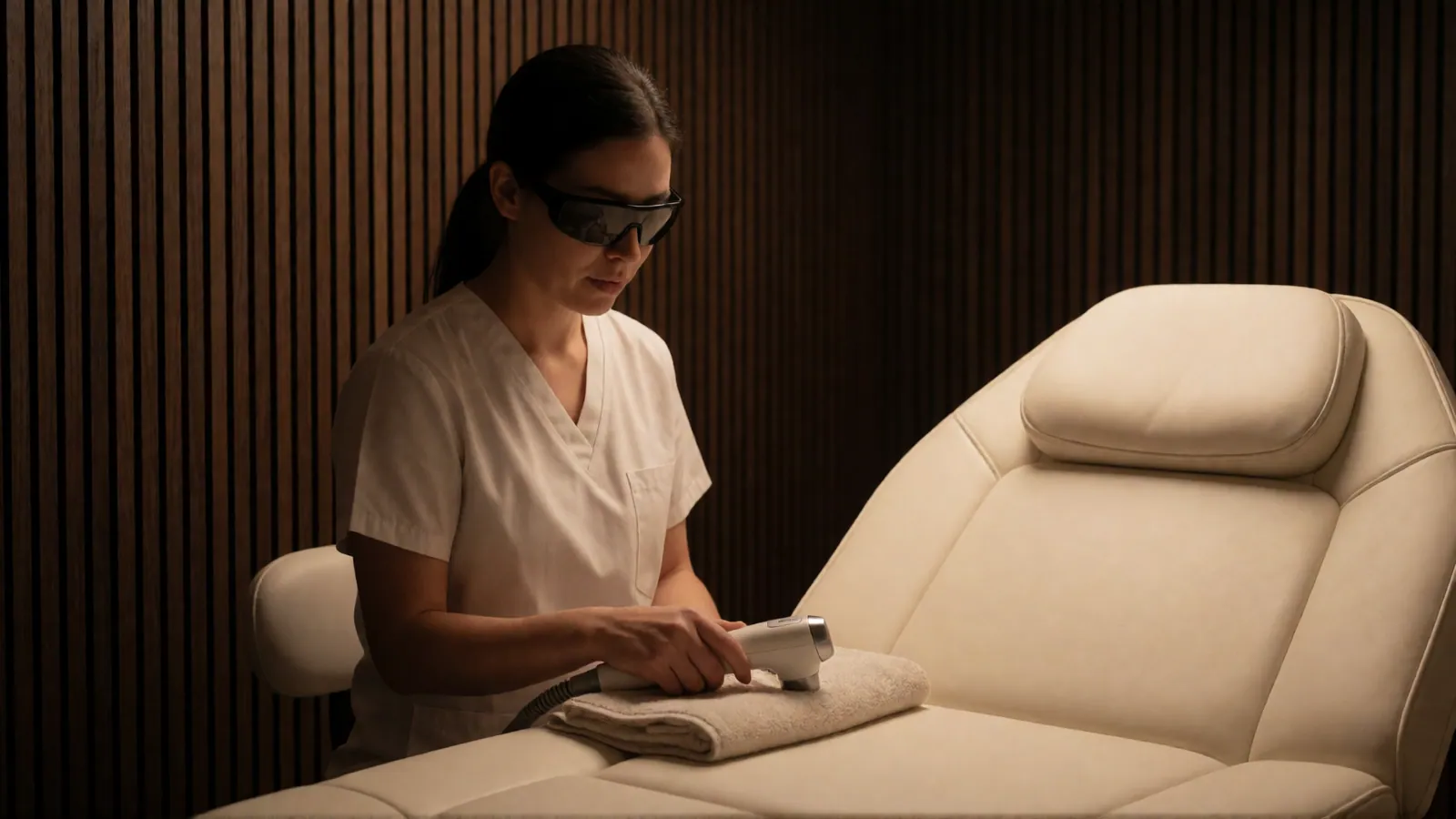
Eyewear on for everybody in the room, cooling on the skin, and a series of pulses that feel like an elastic band snapped against the skin. An upper lip takes two minutes; both legs take about an hour. Redness and small bumps around each follicle afterwards for a few hours are the expected response.
Between sessions
Four weeks for the face, six to eight for the body, following the growth cycle of that area rather than a diary. Shaving between sessions is fine and encouraged; waxing and plucking are not, because they remove the target.
Maintenance
After a full course most people are left with a large reduction and some fine remaining hair, and most want a single session once or twice a year to keep it there. Hormonal areas — the face and chin in particular — need maintenance more often, and we say so before the course rather than at the end of it.
Risks, and who we decline
Complications are uncommon with correct settings and honest screening. They are not rare in an industry where neither is guaranteed.
Burns and blistering
Almost always the result of too much energy for the skin in front of the machine, or of treating over a tan. They heal, but they can leave a mark that lasts months. Conservative settings and a test patch are how this is avoided.
Pigment change
Skin can be left temporarily lighter or darker after treatment, and on richer skin tones the darker sort can persist for many months. It usually resolves with time and rigorous sun protection. It is the reason we assess in daylight rather than under a treatment lamp.
Paradoxical hair growth
Uncommon and genuinely counter-intuitive: treatment occasionally stimulates fine hair to grow at the edge of a treated area, most often on the face and neck of women with certain hair types. It is manageable, it is rarely mentioned, and you should hear about it before a course rather than during one.
We will not treat
Over a tan or a spray tan; anybody taking a medication that makes skin sensitive to light, including several common antibiotics and acne treatments; anybody pregnant; over a tattoo or a mole; where there is an active skin infection; or where the hair has no pigment for the light to find.
Laser Hair Reduction in western Queens
The most reliably satisfying treatment in this building, provided the expectation is right: it is a permanent reduction rather than a permanent removal, and it takes a course spread across months.
Every treatment here starts the same way: a full hour at a table in a room with no treatment couch in it, a proper medical history, your skin looked at in daylight, and then a plain statement of what we think would achieve what you described. You are told what it costs, how many sessions it usually takes, how long it lasts, what the recovery looks like and what can go wrong — on paper, to take home and read somewhere other than a treatment room. If the honest answer is a different treatment, or nothing, or a dermatologist, that is what you get instead, and it costs exactly the same.
Aesthetic treatment is elective medicine, and this page is not medical advice for you. Aesthetic treatment is elective, it is medicine wherever it breaks the skin, and nothing on this website is medical advice for you in particular. We do not diagnose disease. Every treatment here begins with a consultation and a medical history, because your health, your medication, your skin type and what you have had done before all change what is safe and what is sensible. Some people are told no. Being told no is a normal outcome of a consultation here rather than a failure of one, and it costs exactly the same as being told yes.
No before-and-after photographs, and no promised outcome. There are no before-and-after photographs on this website and there never will be. Every set you have seen somewhere else was chosen from a much larger pile, and the second picture is usually taken in different light, at a different angle, at a different time of day, often with makeup and frequently after retouching. Even an entirely honest pair shows you what happened to somebody else's face. What we publish instead is what a treatment typically changes, by roughly how much, how long it lasts, how many sessions it usually takes and how often people are disappointed. We do not guarantee an outcome, we cannot, and anybody who does is either guessing or selling.
The risks, plainly. Every treatment on this site has side effects and some carry real risks. The common ones are minor and short-lived — redness, swelling, tenderness, bruising, a day or two of looking like you have had something done. The uncommon ones matter more: burns, blistering and long-lasting pigment change from light-based treatment, which is a greater risk on deeper skin tones and on recently tanned skin; infection anywhere the skin is broken; and lumps, asymmetry and, very rarely, a blocked blood vessel from injectable filler, which is the one true emergency in this field. We screen for what makes each of these more likely, we tell you your own risk rather than the average one, and we decline to treat when the answer should be no.
What a med spa does not treat. We treat the appearance of healthy skin, hair and body. We do not diagnose or treat disease. If you bring us a mole, a changing mark, an unexplained rash, a sore that will not heal, skin that has become hard or numb, psoriasis, eczema, an autoimmune skin condition, or hair loss that came on suddenly or in patches, what you will get is the name of a doctor rather than a treatment plan. Aesthetic treatment applied on top of an undiagnosed skin problem can mask it, delay the diagnosis and occasionally make it worse. We would rather lose the booking.
Questions
Laser Hair Reduction — the questions we are asked most
Is it permanent?
The follicles the treatment destroys do not grow hair again, so that part is permanent. What it is not is total removal: some follicles survive each session, new ones can be activated by hormonal change, and most people are left with a large reduction plus fine remaining hair. The correct phrase is permanent reduction, and a clinic promising permanent removal is over-promising.
Will it work on my blonde, red, grey or white hair?
No. Not here and not anywhere, whatever you have been told. The treatment works by light being absorbed by pigment in the hair, and hair without pigment gives the light nothing to find. We will tell you this at the consultation rather than after you have paid for three sessions, and it is one of the more common conversations we have.
Is it safe on dark skin?
With the right wavelength, conservative settings and a test patch, yes — and it is done here routinely. Without those, the risk of burns and long-lasting pigment change is genuinely higher, because the light is absorbed by skin as well as by hair. Anywhere that will not test patch you, or that cannot tell you what they intend to use and why, should not be treating you.
How much does it hurt?
Like an elastic band snapped against the skin, repeated. Most people tolerate it easily on the legs and underarms and find the upper lip and bikini line sharper. Cooling is applied throughout. No numbing is normally needed, though we will use some for a first bikini session if you would like it.
Can I shave between sessions?
Yes — shaving is required rather than merely allowed, because the treatment needs the follicle intact and the surface hair gone. What you must not do is wax, pluck, thread or epilate for four weeks before any session, because those remove the root the laser is aiming at.
I am going on holiday. Can I have a session first?
Not immediately before, and not immediately after. Treated skin is more sensitive to sun for a fortnight, and treating skin that has recently been in strong sun is the commonest cause of a burn. Leave two weeks either side, use a high-factor sunscreen on the area, and plan a course around the winter rather than around June.
Related
Often seen alongside this
Laser & Light
Laser Skin Resurfacing
Controlled removal of the surface of the skin so that it heals back smoother, or controlled heating beneath it without breaking the surface. The first works better; the second costs you nothing in downtime.
Read more
Laser & Light
IPL Photofacial
A broad flash of filtered light absorbed by brown patches and red vessels, which breaks them up so the body can clear them. Excellent for sun damage on lighter skin — and genuinely risky on richer skin.
Read more
Laser & Light
Laser Vein Treatment
Light absorbed by blood inside a small unwanted vessel heats it enough to close it, and the body clears it over weeks. Good for facial vessels and fine leg veins — and not a treatment for varicose veins.
Read moreA written plan and a written price before anything is booked
Book a consultation
Pick a clinician and an hour from the calendar — it shows only the times each of them genuinely has free. A consultation is a full hour at a table with no treatment couch in the room, and it costs $85, or $120 with the medical director. If you go ahead, that comes off your first treatment. If we tell you the answer is nothing, or a dermatologist, it costs exactly the same.