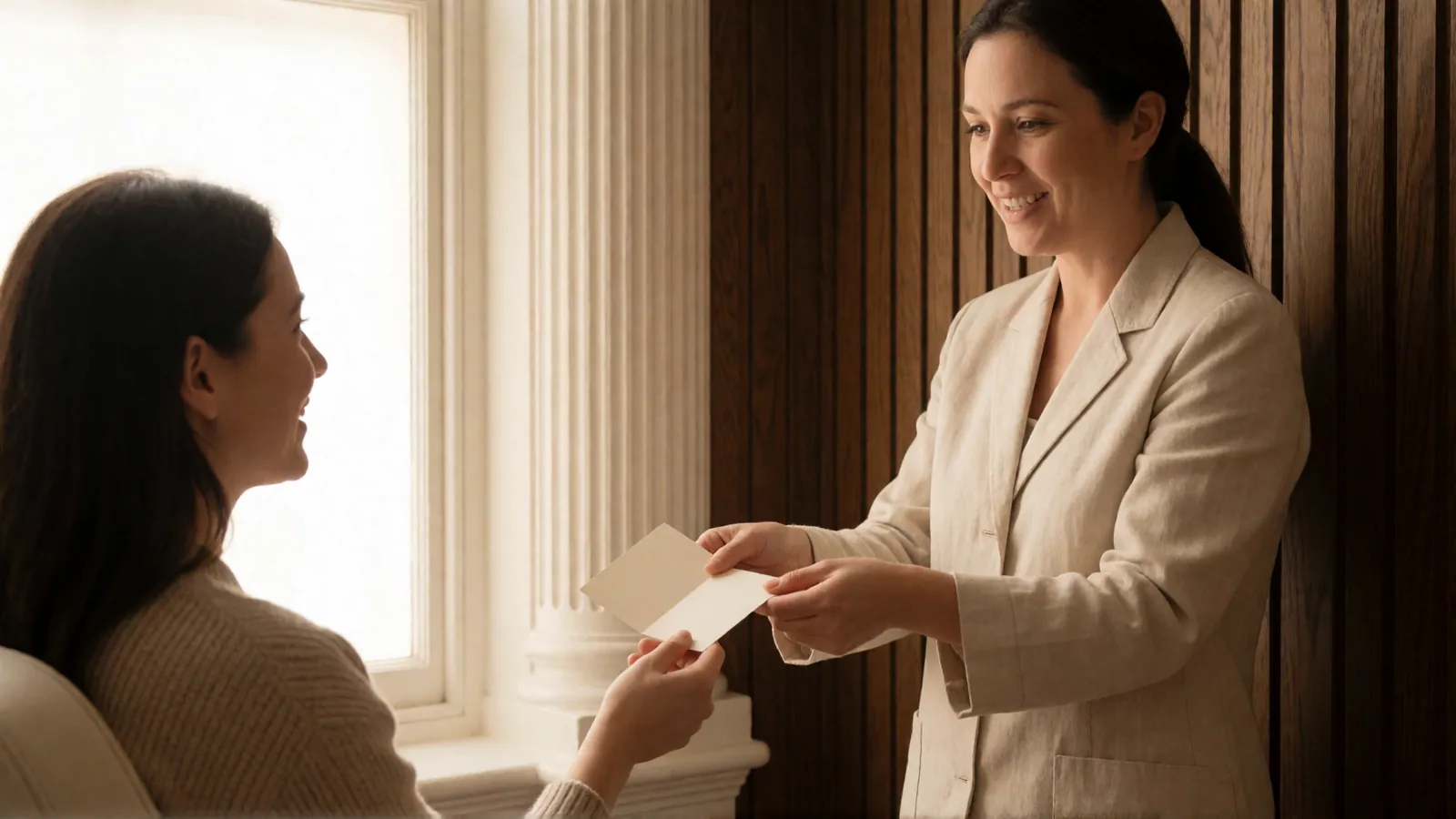
The booking
You pick a clinician and a time from the calendar on /appointments.html, or you telephone and we do it for you. The calendar shows only hours that are genuinely free — it is reading the same schedule the clinician keeps, so an hour on screen is an hour you can have.
A full hour at a table
The consultation happens in a room with a table, two chairs and no treatment couch, because it is very difficult to decline something while lying down with your face cleaned. History first: your health, your medication, what you have had done before, what you are planning in the next three months. Then your skin, in daylight, with a mirror you hold yourself.
What we think, in plain words
You are told what we believe would achieve what you described, what it would cost, how many sessions it usually takes, how long it lasts, what the recovery looks like and what could go wrong. Frequently the recommendation is cheaper or slower than what you came in asking for. Sometimes it is nothing at all.
A written plan, taken home
You leave with it on paper: the treatment, the price, the risks and the aftercare, so that you read the risk section somewhere other than a treatment room with a clinician waiting. Nothing is booked at that appointment unless you ask for it to be.
The treatment itself
In a private suite, with the same clinician, with everything explained again before it starts. You can stop at any point, including after we have begun, and nobody will talk you through something you have said you want to stop.
A review, at two weeks
Free, and in our diary whether or not it is in yours. Injectables are judged at two weeks rather than on the day; skin programmes are judged at three months. This is the appointment where a small adjustment gets made and where we find out honestly whether something worked.
The room with no couch in it
Where you decide is not where you are treated
This is the most deliberate design decision in the building and it costs us money. A consultation room that cannot be converted into a treatment room means an hour of a clinician's day that produces no treatment, quite often followed by somebody deciding against the thing they came in for.
It exists because of how the rest of this industry works. The standard sequence is a consultation in the treatment chair, the face cleaned, the plan described, and the treatment offered immediately at a moment when saying no requires interrupting somebody who is already holding something. A surprising number of people find that they cannot.
So: a table, two chairs, a window, a mirror you hold yourself, and a piece of paper you take home. If you come back, you come back having decided somewhere else.

What you can expect from us
Six things, every time
- The same clinician each visit, in their own suite, on their own schedule
- A written plan and a written price before anything is booked
- The risks and the recovery on paper, to read at home rather than in the room
- Everything explained again before it starts, and stopped the moment you say stop
- A free review at two weeks after any injectable, whether or not you ask for one
- No charge, ever, for managing a complication we caused
No before-and-after photographs, and no promised outcome. There are no before-and-after photographs on this website and there never will be. Every set you have seen somewhere else was chosen from a much larger pile, and the second picture is usually taken in different light, at a different angle, at a different time of day, often with makeup and frequently after retouching. Even an entirely honest pair shows you what happened to somebody else's face. What we publish instead is what a treatment typically changes, by roughly how much, how long it lasts, how many sessions it usually takes and how often people are disappointed. We do not guarantee an outcome, we cannot, and anybody who does is either guessing or selling.
Questions
How treatment works — the questions we are asked most
Why will you not treat me at the first appointment?
For injectables, because it is very hard to change your mind while lying down with somebody standing over you holding a syringe, and a decision made in that position is not really a decision. You get the plan and the risks on paper, you read them at home, and you book if you still want it. Skin and laser treatment is often done the same day once you have consented.
What is the two-week review for?
Looking at the result in daylight together, and making a small adjustment if one area was under-treated. It is free and it is in our diary automatically. Judging an injectable on the day it was done is judging it before the treatment has finished happening, and correcting at two weeks is the difference between a natural result and the slow creep toward too much.
What if I want to stop halfway through a course?
Then you stop, and you owe nothing further. Nothing here is bought in advance, so a course is simply a series of appointments you can end at any point. Nobody will telephone you to ask why.
Do you keep records?
Yes — a medical history, what was done, where, how much, at what settings, and any photographs taken for assessment. That record is what makes the next treatment safe and what a complication is managed from. It is yours, it is not published anywhere, and it is deleted on request.
Will I see the same person every time?
Yes. Each clinician keeps their own book and their own suite, and continuity matters more in this field than people expect: what was done last time, where, and how your tissue responded is most of what makes the next treatment good.
How far ahead should I book?
For anything with downtime, further ahead than you think, and never in the week before an event. If you have a date in mind, tell us the date first and we will work backwards honestly — including telling you when it cannot be done, which happens most often in April with a June wedding.
Aesthetic treatment is elective medicine, and this page is not medical advice for you. Aesthetic treatment is elective, it is medicine wherever it breaks the skin, and nothing on this website is medical advice for you in particular. We do not diagnose disease. Every treatment here begins with a consultation and a medical history, because your health, your medication, your skin type and what you have had done before all change what is safe and what is sensible. Some people are told no. Being told no is a normal outcome of a consultation here rather than a failure of one, and it costs exactly the same as being told yes.
A written plan and a written price before anything is booked
Book a consultation
Pick a clinician and an hour from the calendar — it shows only the times each of them genuinely has free. A consultation is a full hour at a table with no treatment couch in the room, and it costs $85, or $120 with the medical director. If you go ahead, that comes off your first treatment. If we tell you the answer is nothing, or a dermatologist, it costs exactly the same.