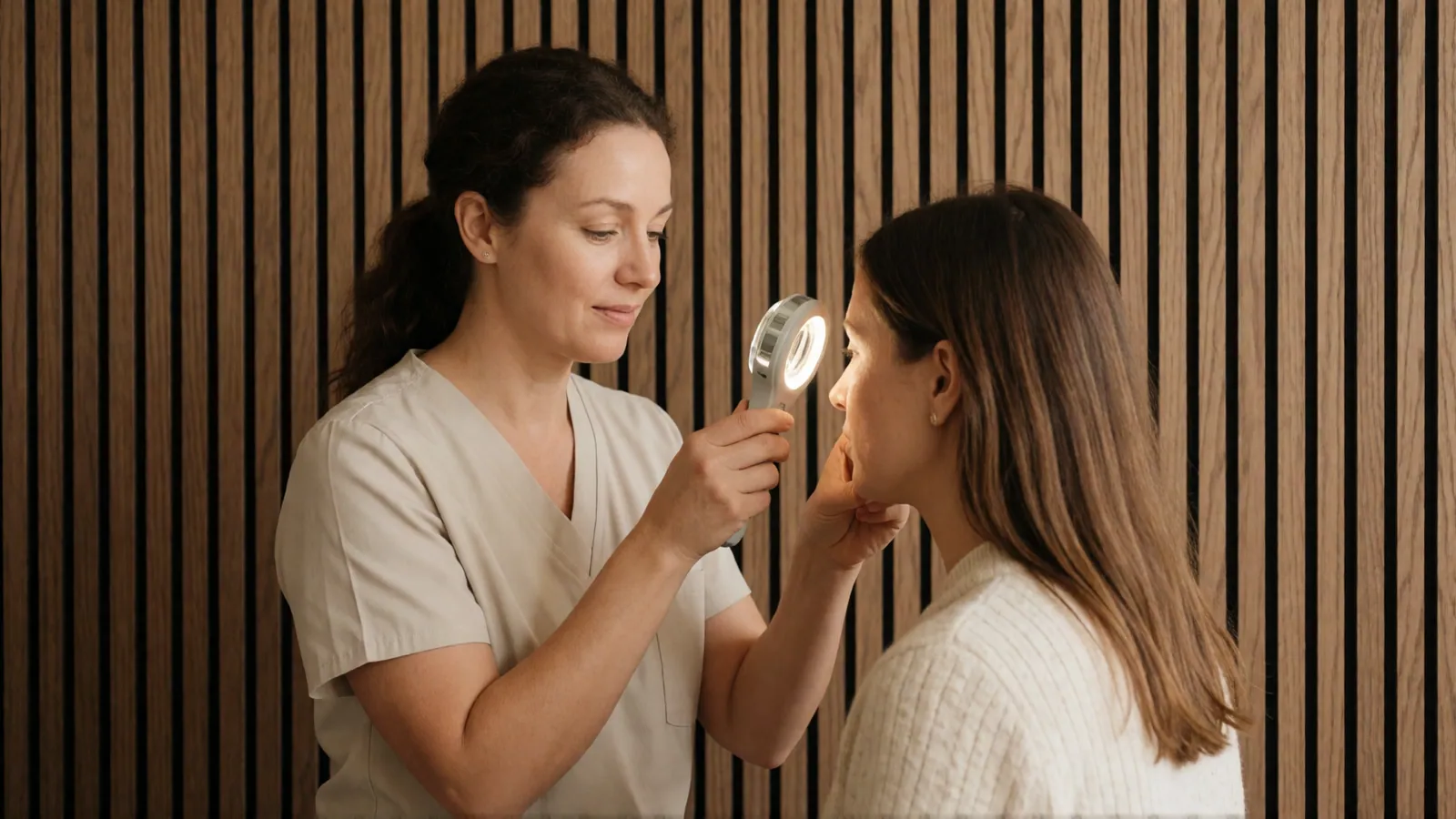
Some things people bring to a med spa need a doctor rather than a treatment room. Some things people bring to a med spa are not aesthetic problems and need a doctor rather than a treatment room. See a physician or a dermatologist, not us, if you have a mole or a mark that has changed shape, colour or size, or that bleeds, itches or will not heal; a sore anywhere that has been there more than three weeks; a rash you cannot explain; a patch of skin that is newly numb, hard or ulcerated; sudden hair loss in patches, or hair loss alongside fatigue or weight change; or swelling, heat and spreading redness that could be an infection. And if you have had filler treatment anywhere and the area becomes white or mottled, severely painful, or your vision changes, that is an emergency — telephone us immediately if we treated you, and go to an emergency room if you cannot reach somebody within minutes. We would far rather you rang a doctor and never rang us at all.
A dark or hollow under-eye has at least four possible causes and they need four different answers. It can be a genuine loss of volume, leaving a trough where the lower eyelid meets the cheek — that one responds well to a small amount of filler. It can be pigment in the skin itself, which is common in richer skin tones and which filler does nothing at all for. It can be very thin skin showing the blue of the vessels beneath, which filler helps only slightly. Or it can be a fat pad that has bulged forward, which is a surgical problem and which filler makes worse.
Telling those apart is the whole consultation, and it is why this is the one treatment where we most often send somebody away without booking anything. Filling a hollow that is actually a bulge produces a heavier, puffier under-eye that lasts a year. Filling a pigment problem produces a hollow that is exactly as dark as it was and a client who quite reasonably feels they wasted their money.
Where it is right, the effect is out of proportion to the amount used — a fraction of a syringe on each side, placed deep, changes how rested a whole face looks. It is also, technically, the least forgiving injection on the face: the skin is under a millimetre thick, the tissue holds water enthusiastically, and product placed a few millimetres too shallow shows as a bluish ridge that can sit there for a year. We treat it conservatively, with a blunt cannula, and only with the medical director.

Which under-eye is which
Four causes, four different answers. This is what the consultation is actually establishing.
A true hollow
A groove where the lid meets the cheek, deeper when you smile, casting a shadow that changes with the light. This is volume loss and it is the one that responds. A small amount of a soft product placed on the bone fills the trough and the shadow goes with it.
Pigment in the skin
A brown or grey discolouration that stays the same colour whichever way you tilt your head, often inherited, and more common in richer skin tones. Filler does nothing for this. What helps is pigment-directed skin treatment, rigorous sun protection and realistic expectations, and we will say so rather than sell you a syringe.
Thin skin over vessels
A bluish tinge you can see the veins through, which often runs in families and is worse when tired or dehydrated. Filler placed deep helps a little by adding a layer between the vessels and the surface. Skin-thickening treatment — microneedling, some resurfacing — helps more, and slowly.
A bulging fat pad
A puffiness that is worse in the morning and worse after salt, sitting above the hollow rather than in it. Filling below a bulge accentuates it. This is an oculoplastic surgical problem, we will tell you so, and no amount of product placed here is going to be the answer.
How we treat it, when we treat it
Conservative, deep, and with the medical director rather than with whoever has the appointment free.
A cannula rather than a needle
A blunt-tipped tube introduced through one entry point, which pushes vessels aside rather than piercing them. It reduces the risk of bruising substantially and the risk of a vascular problem considerably, and it is the standard of care for this area.
A very small amount, placed deep
A quarter to a half of a syringe per side is normal, laid on the bone rather than under the skin. Product placed too superficially in this area is the single commonest visible error in aesthetics, and it produces a bluish, swollen ridge that people live with for a year because nobody told them it could be dissolved.
Stop early, review at two weeks
This tissue holds water, so an under-eye treated to look perfect on the day is an under-eye that will be puffy in a fortnight. We deliberately under-fill and add at the review if it is needed.
It can be dissolved
And in this area, more often than anywhere else, it should be if the result is not right. The enzyme works within a day or two. Anybody living with a bluish swelling under their eye from a treatment elsewhere should know that it does not have to be waited out.
Risks and reasons to decline
This area carries the ordinary injectable risks plus several of its own.
Prolonged swelling
Far more common here than elsewhere. Some people hold fluid in this tissue for weeks, and it is worse in anybody whose under-eye already puffs after salt or a poor night. We ask about that specifically, and it is a reason we sometimes decline.
The Tyndall effect
Product placed too shallow scatters light and looks blue-grey through thin skin. It is an error rather than a risk, it is avoidable with correct depth, and it is why this area should not be treated by somebody learning.
Vascular complication
Rare, and the reason this is done with a cannula by the medical director. The under-eye connects toward the vessels supplying the eye, so severe pain, skin colour change or any visual change after treatment is an emergency. The management is on site and you leave able to describe the signs.
We will decline if
The cause is pigment or a bulging fat pad; you are prone to under-eye swelling; you have significant loose lower-lid skin, where filler weighs it down further; or you are pregnant or breastfeeding. Roughly half the people who ask for this treatment here are advised against it, and that number is not an accident.
Under-Eye Treatment in western Queens
The hollow under the eye is the most technically demanding area on the face and the one most often treated badly. Half the people who ask for it here are advised against it, and the reasons are on this page.
Every treatment here starts the same way: a full hour at a table in a room with no treatment couch in it, a proper medical history, your skin looked at in daylight, and then a plain statement of what we think would achieve what you described. You are told what it costs, how many sessions it usually takes, how long it lasts, what the recovery looks like and what can go wrong — on paper, to take home and read somewhere other than a treatment room. If the honest answer is a different treatment, or nothing, or a dermatologist, that is what you get instead, and it costs exactly the same.

Aesthetic treatment is elective medicine, and this page is not medical advice for you. Aesthetic treatment is elective, it is medicine wherever it breaks the skin, and nothing on this website is medical advice for you in particular. We do not diagnose disease. Every treatment here begins with a consultation and a medical history, because your health, your medication, your skin type and what you have had done before all change what is safe and what is sensible. Some people are told no. Being told no is a normal outcome of a consultation here rather than a failure of one, and it costs exactly the same as being told yes.
No before-and-after photographs, and no promised outcome. There are no before-and-after photographs on this website and there never will be. Every set you have seen somewhere else was chosen from a much larger pile, and the second picture is usually taken in different light, at a different angle, at a different time of day, often with makeup and frequently after retouching. Even an entirely honest pair shows you what happened to somebody else's face. What we publish instead is what a treatment typically changes, by roughly how much, how long it lasts, how many sessions it usually takes and how often people are disappointed. We do not guarantee an outcome, we cannot, and anybody who does is either guessing or selling.
The risks, plainly. Every treatment on this site has side effects and some carry real risks. The common ones are minor and short-lived — redness, swelling, tenderness, bruising, a day or two of looking like you have had something done. The uncommon ones matter more: burns, blistering and long-lasting pigment change from light-based treatment, which is a greater risk on deeper skin tones and on recently tanned skin; infection anywhere the skin is broken; and lumps, asymmetry and, very rarely, a blocked blood vessel from injectable filler, which is the one true emergency in this field. We screen for what makes each of these more likely, we tell you your own risk rather than the average one, and we decline to treat when the answer should be no.
What a med spa does not treat. We treat the appearance of healthy skin, hair and body. We do not diagnose or treat disease. If you bring us a mole, a changing mark, an unexplained rash, a sore that will not heal, skin that has become hard or numb, psoriasis, eczema, an autoimmune skin condition, or hair loss that came on suddenly or in patches, what you will get is the name of a doctor rather than a treatment plan. Aesthetic treatment applied on top of an undiagnosed skin problem can mask it, delay the diagnosis and occasionally make it worse. We would rather lose the booking.
Questions
Under-Eye Treatment — the questions we are asked most
Will this get rid of my dark circles?
It depends entirely on what is causing them, and for a large share of people the answer is no. Filler addresses shadow cast by a hollow. It does nothing for pigment in the skin, very little for thin skin over blue vessels, and it makes a bulging fat pad look worse. Establishing which of those you have is the purpose of the consultation, and being told no here is common.
Why is this more expensive than other filler?
Because it takes longer, it is done with a cannula, it is performed only by the medical director, and the consequences of doing it badly last a year. The price also includes the two-week review and, if the result is not right, the conversation about dissolving it rather than living with it.
How long does it last?
Often longer than filler elsewhere — twelve to eighteen months is common, because the area moves very little. That is a mixed blessing: a good result lasts, and so does a poor one, which is another reason for treating conservatively and reviewing before adding.
What is the recovery?
Bruising is likely — this is thin skin over a lot of small vessels — and swelling for up to a week, sometimes longer. With a cannula the bruising is much reduced but not eliminated. Do not have this done within three weeks of an occasion where you will be photographed.
I had this done elsewhere and it looks puffy and blue. Can it be fixed?
Yes, and you do not have to wait it out. That appearance is almost always product placed too superficially, and the enzyme that dissolves it works within a day or two. Come in for a consultation, we will look at it honestly, and we will tell you if dissolving is the right answer — including if the right answer is to dissolve and not to replace it.
Can this treat eye bags?
No. A bag is a fat pad that has come forward through a weakened barrier, and adding volume beneath it makes the whole area heavier. That is a surgical problem for an oculoplastic surgeon and we will tell you so plainly at the consultation rather than treating around it.
Related
Often seen alongside this

Injectables & Facial Balancing
Wrinkle-Relaxing Injections
A small amount of a purified protein placed in a specific muscle so it stops pulling as hard. It softens the lines that appear when you move. It does very little to the lines that are there when your face is still.
Read more
Injectables & Facial Balancing
Dermal Fillers
A gel placed under the skin to restore volume or change a contour. It works immediately and lasts months to years. It is also the treatment in this building with the smallest margin for error.
Read more
Injectables & Facial Balancing
Lip Enhancement
Filler placed in the lip to restore what has thinned, improve a shape or balance an asymmetry. Done well it is unremarkable. Done to excess it is the most recognisable treatment in aesthetics.
Read moreA written plan and a written price before anything is booked
Book a consultation
Pick a clinician and an hour from the calendar — it shows only the times each of them genuinely has free. A consultation is a full hour at a table with no treatment couch in the room, and it costs $85, or $120 with the medical director. If you go ahead, that comes off your first treatment. If we tell you the answer is nothing, or a dermatologist, it costs exactly the same.